
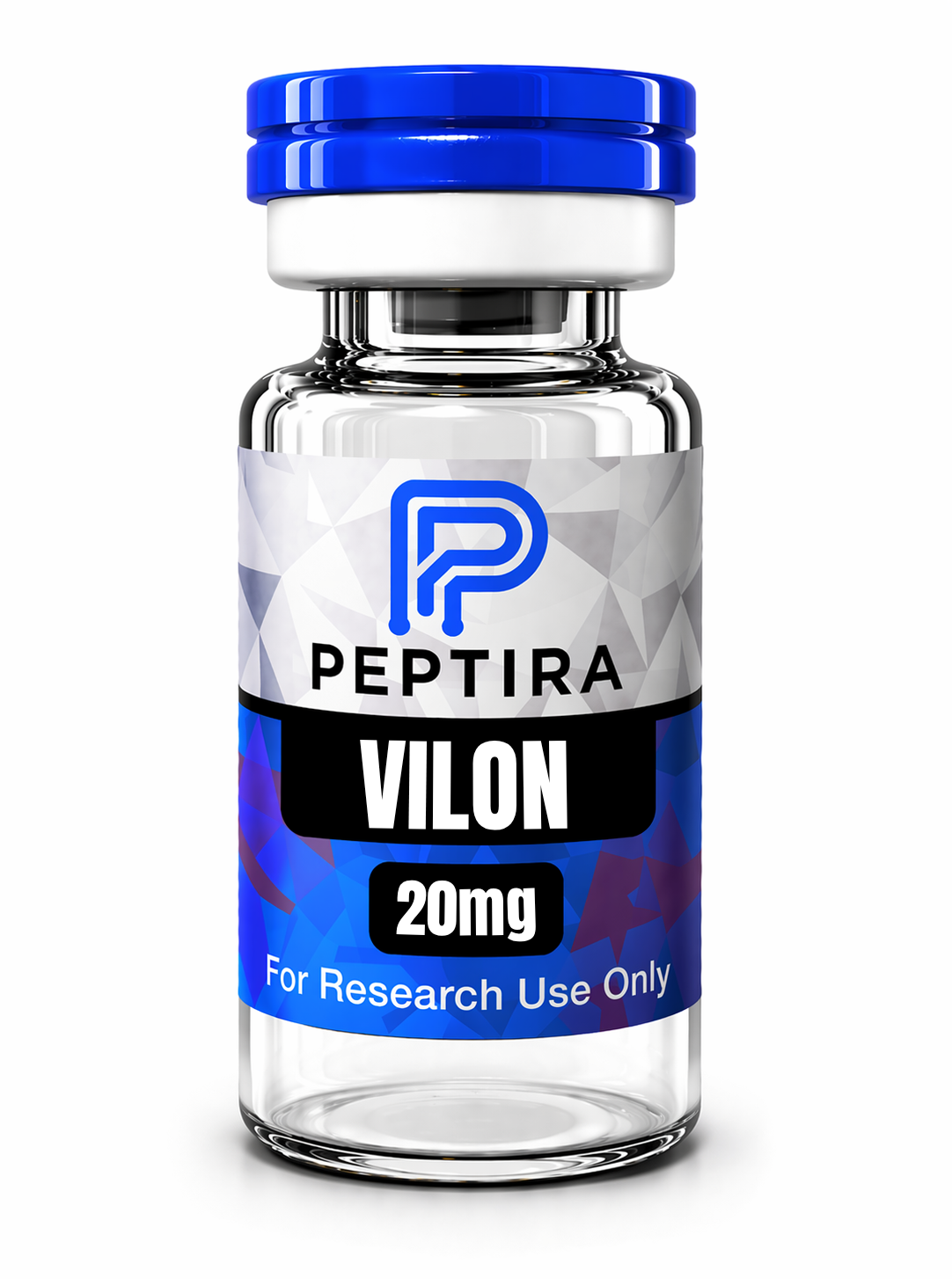
Vilon

$50.00
Vilon is a synthetic Lys-Glu dipeptide studied as a peptide bioregulator in laboratory research. Research has explored its effects on cellular signaling, gene-expression-related processes, immune-cell biology, and tissue-specific activity. This product is intended for research purposes only and is not intended for human or veterinary use.
Vilon – Bioregulator Research Material
Vilon Research
Vilon is a synthetic short peptide consisting of the amino acid sequence Lys-Glu (KE). It is commonly studied within the group of short peptide bioregulators associated with the Khavinson research program. Because of its simple two-amino-acid structure, Vilon provides researchers with a small peptide model for investigating peptide-mediated cellular and molecular processes.
Bioregulator Research
Research involving Vilon has focused on the broader concept of short peptides as potential regulators of cellular processes. Experimental studies have investigated how Vilon and related peptides may influence biological activity at the cellular and tissue level. These studies are primarily useful for understanding peptide biology and mechanisms rather than establishing clinical effects.
Cellular and Molecular Studies
Vilon has been investigated in laboratory models involving cellular regulation. One PubMed-indexed study examined Vilon alongside other short peptides in human THP-1 monocyte-derived cellular models and reported changes in inflammatory and proliferative signaling markers. These findings provide a basis for further laboratory investigation of short peptide interactions with cellular pathways.
Apoptosis Research
Experimental research has also examined Vilon in relation to programmed cell death. A study using rat spleen lymphocytes investigated the effects of Vilon and Epithalon on radiation-induced apoptosis. The researchers reported changes in apoptosis-related activity in the experimental model. Because this work was performed in animals and isolated cells, the findings should be interpreted as preclinical research rather than evidence of established human effects.
Tissue-Specific Research
The concept of tissue-specific activity is another area associated with Vilon research. Published experimental work compared several synthetic peptides and reported different effects in organotypic cultures derived from tissues including the brain cortex, liver, and thymus. Such studies are relevant to researchers investigating whether short peptide sequences can produce tissue-dependent biological responses.
Gene Expression and Cellular Biology
Additional research has investigated short peptide bioregulators in relation to chromatin and gene activity. A study involving Vilon and other synthetic peptides examined changes in chromatin organization and ribosomal gene activity in lymphocytes from older subjects. These observations have contributed to research into possible relationships between short peptide sequences and cellular gene regulation.
Peptide Chemistry
From a research perspective, Vilon’s small molecular structure makes it useful as a model compound when studying short peptide chemistry. Its Lys-Glu sequence allows researchers to investigate how a minimal peptide sequence interacts with biological systems and how short peptides can be evaluated in controlled laboratory environments.
Laboratory Research Applications
Vilon may be included in research involving peptide bioregulation, cellular signaling, gene-expression studies, apoptosis models, immune-cell research, tissue biology, and comparative peptide investigations. Researchers should rely on the exact product specifications, analytical documentation, and lot-specific information supplied with their material when designing experiments.
Research Evidence
The published Vilon literature includes cellular, animal, and human-related research reports. However, the evidence base is heterogeneous, and findings from experimental models should not be interpreted as established therapeutic benefits. Independent replication and modern controlled research remain important when evaluating proposed biological mechanisms.
Product Identification
Vilon is commonly identified as the Lys-Glu (KE) synthetic dipeptide. It should not be confused with longer peptides that share the Lys-Glu sequence, such as Livagen, which contains additional amino acids. Researchers should verify the exact identity, composition, and specifications of the material against the product label and applicable analytical documentation.
Research Use Only
Vilon supplied by Peptira is intended for laboratory research purposes only. It is not presented as a medicine, dietary supplement, or treatment for any disease or medical condition.
Important Research Notice
Research findings described above are provided for scientific and educational context. Experimental results from cells or animals do not establish equivalent effects in humans. Researchers should follow applicable institutional procedures, laboratory safety requirements, and regulations when working with peptide research materials.
Be the first to review “Vilon”
Related products
Bioregulators

Bioregulators
Bioregulators

Bioregulators
Bioregulators
Reviews
There are no reviews yet.