
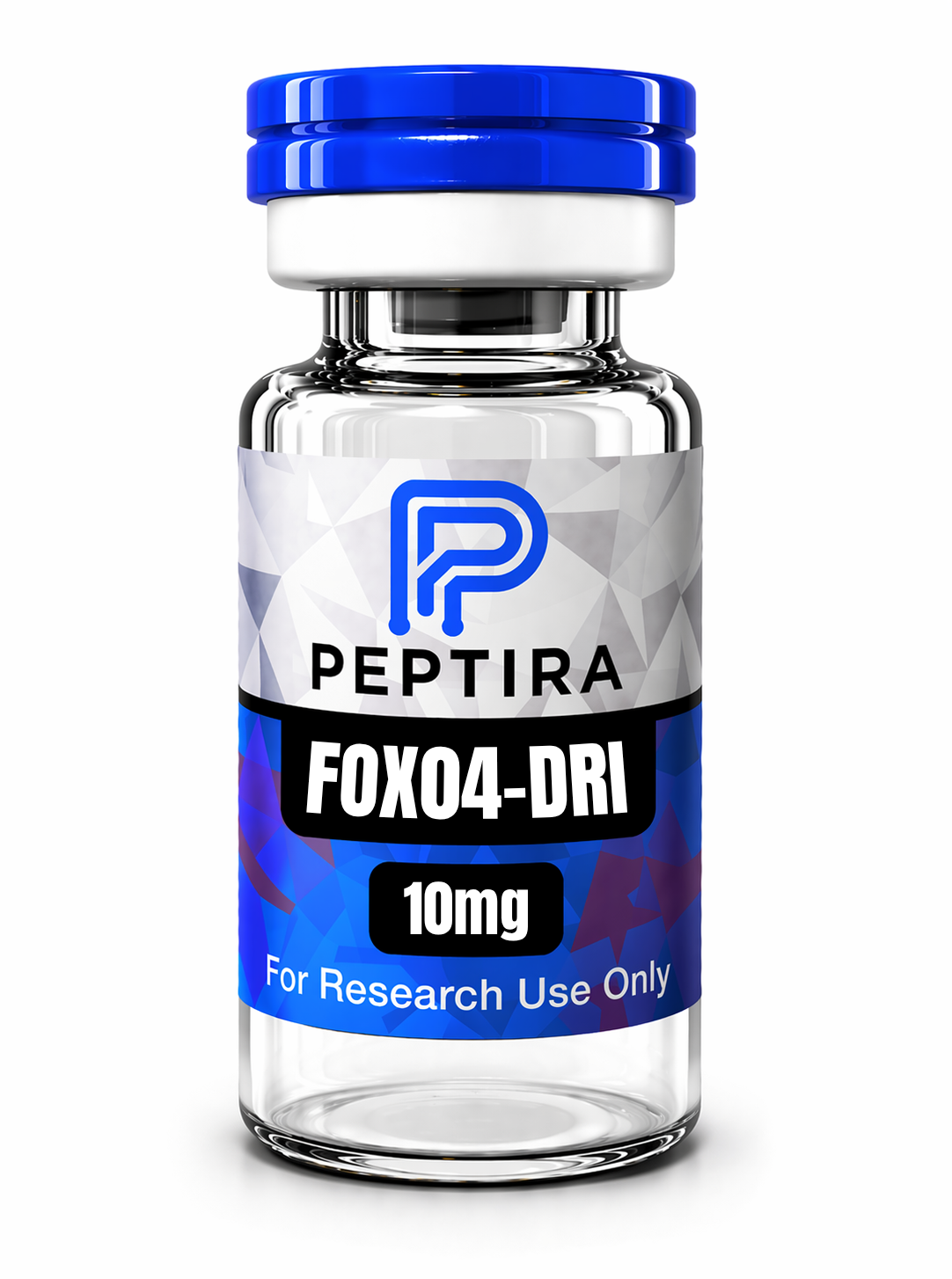
FOX04-DRI
$145.00
FOXO4-DRI is an experimental peptide studied in cellular senescence, apoptosis, protein–protein interactions, and molecular aging research. Studies have investigated its ability to disrupt the interaction between FOXO4 and p53, resulting in p53-dependent apoptosis of senescent cells in experimental models. FOXO4-DRI is intended for qualified laboratory research only and is not intended for human or veterinary use.
FOXO4-DRI – Research Peptide Material
FOXO4-DRI Peptide Research
FOXO4-DRI is an experimental peptide developed to investigate the molecular relationship between the forkhead transcription factor FOXO4 and the tumor-suppressor protein p53. The peptide uses a D-retro-inverso (DRI) design and has been studied as a research tool for investigating cellular senescence and programmed cell death.
FOXO4-p53 Interaction Research
A major area of FOXO4-DRI research involves the FOXO4–p53 protein interaction. In senescent cells, FOXO4 can help maintain p53 within the nucleus and contribute to continued cell survival. Experimental studies found that FOXO4-DRI can compete with FOXO4 for interaction with p53, providing researchers with a molecular tool for studying this pathway.
Cellular Senescence Research
Cellular senescence is characterized by stable cell-cycle arrest and changes in cellular signaling and secretory activity. FOXO4-DRI has been investigated as an experimental senolytic peptide because studies have observed selective effects on senescent cells under specific experimental conditions. Research has included cultured human cells as well as animal models.
Apoptosis and Molecular Signaling
Research indicates that disrupting the FOXO4-p53 interaction with FOXO4-DRI can promote the nuclear exclusion of p53 and activate apoptosis-related signaling in senescent cells. Experimental studies have investigated pathways involving p53 and downstream apoptotic mechanisms, providing researchers with a model for examining protein-interaction-driven cell death.
D-Retro-Inverso Peptide Design
FOXO4-DRI uses a D-retro-inverso peptide configuration, an approach in which peptide stereochemistry and sequence orientation are modified to investigate peptide stability, molecular recognition, and biological activity. Published structural research has further characterized the interaction between FOXO4-DRI and the p53 transactivation domain.
Laboratory Research Applications
FOXO4-DRI can be relevant to laboratory investigations involving cellular senescence, apoptosis, protein–protein interactions, p53 signaling, peptide chemistry, and molecular aging biology. Researchers may also use the compound in comparative studies examining senescent and non-senescent cellular models.
Recent research has continued to investigate the structural basis of FOXO4-DRI binding to p53, expanding understanding of this experimental peptide and the FOXO4-p53 signaling relationship.
Experimental Research Context
FOXO4-DRI has been studied in several experimental systems, including senescent fibroblasts, endothelial cells, chondrocytes, and animal models. These studies provide research evidence for investigating senescence-associated mechanisms, but experimental findings should not be interpreted as proof of clinical efficacy or human safety.
Research Material and Documentation
Researchers working with FOXO4-DRI should verify the exact peptide identity, sequence, stereochemistry, molecular weight, and analytical documentation associated with each research lot. Published sources describe FOXO4-DRI as a D-amino-acid peptide and report specific sequence and structural information, making accurate characterization important for reproducible laboratory research.
Laboratory Research Use Only
FOXO4-DRI is supplied as experimental research material for qualified scientific and laboratory applications. It is not intended for human consumption, self-administration, diagnosis, treatment, or prevention of disease.
Important Research Notice
This product is intended strictly for research and laboratory use only. Research findings involving FOXO4-DRI have primarily been generated in experimental cellular and animal models. Product specifications should not be interpreted as human dosing or administration instructions. Researchers should follow appropriate institutional laboratory procedures, safety requirements, and applicable regulations when handling experimental peptide materials.
Be the first to review “FOX04-DRI”
Related products
Peptides
Peptides
Peptides
Peptides
Peptides
Peptides
Reviews
There are no reviews yet.